

Dynasty rookie pick values: what picks become
A rookie pick is a bet on a player who hasn't been drafted yet. FleeceRoom values it two ways: what players taken in that range have scored in their first three seasons, and where the pick is likely to land in your league. This guide shows both.
Open FleeceRoom with your league
What picks have turned into
FleeceRoom slots every NFL draft class from 2006 to 2022 the way a 12-team Superflex rookie draft would have taken them, then looks at what the players in each range scored in their first three seasons, in full PPR scoring. The slotting is an assumption: real leagues draft differently, and the numbers are history, not a promise.
- Early 1st (1.01-1.04): a typical rookie season of 12.7 points a game, 14.5 in year two and 14.4 in year three. 85% had a season at weekly-starter level within three years, and 79% broke out.
- Mid 1st (1.05-1.08): 9.8, 10.8 and 11.7 points a game in years one to three; 59% had a starter season, 47% broke out.
- Late 1st (1.09-1.12): 8.6, 10.0 and 9.8; 57% had a starter season, 47% broke out.
- 2nd round: 5.5, 7.0 and 5.6; 38% had a starter season, 30% broke out.
"Weekly-starter level" means a season at the line of a QB24, RB30, WR36 or TE12. A breakout is a season at that level that's also 4 or more points a game above where the player had been. A season under six games counts as zero, so the typical numbers include the busts.
The gap between an early first and the rest is the biggest step in the table. Mid and late firsts are close to each other, and seconds are a long way behind. Running backs taken in the first round reached starter level most often; quarterbacks outside the early firsts did so less often than other positions. Third-round picks and later don't enter FleeceRoom's projections as rookies.
How a pick's value moves with its slot
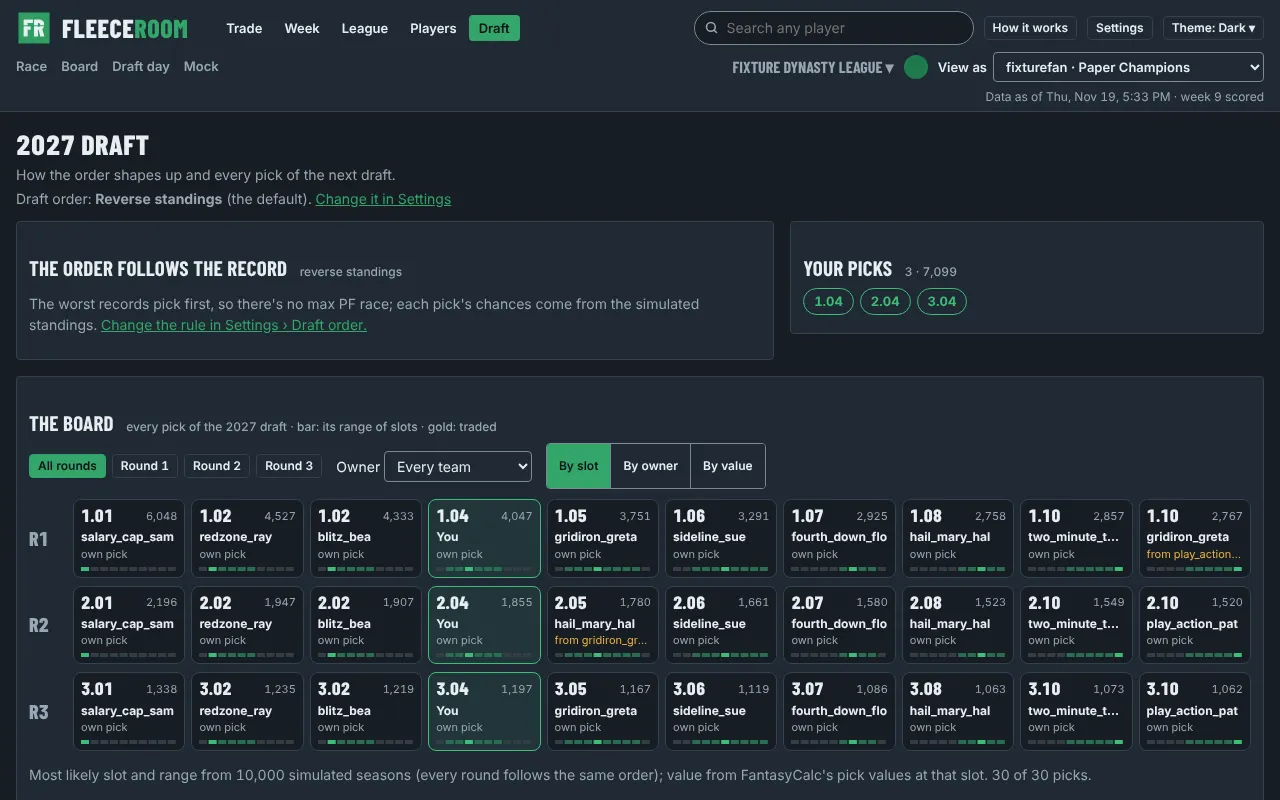
During the season nobody knows where a pick will land. FleeceRoom plays out the rest of your season 10,000 times with your schedule and scoring, orders each simulated draft by your league's rule, and counts how often each team's pick lands at each slot.
- The label shows the most likely slot and the range, for example "1.03 (1.01-1.06)". The range runs from the 10th to the 90th percentile of the slots.
- The value adds up the pick's chance at every slot times that slot's value, from a curve through FantasyCalc's early, mid and late values for that round.
- The tier for the rookie numbers above is the third of the round its most likely slot falls in. Picks two or more drafts away count as mid firsts, since their slot can't be known yet.
So a first-round pick's value rises as its original team falls in the standings, or in max PF in a max PF league. The rookie draft order guide explains the rules that decide it.
Picks in Three years out
FleeceRoom's Three years out turns your future picks into rookies in their draft season: a dashed tile such as "Rookie WR, from your 2027 1st", at the position where that rookie adds the most to your lineup, scoring what its tier has scored. It's how a pick shows up in your contender window.
Frequently asked questions
Where do these numbers come from?
From nflverse's historical NFL stats, CC BY 4.0: every class from 2006 to 2022, slotted as a 12-team Superflex rookie draft would take them, and scored in full PPR.
Is an early first worth two mid firsts?
The history can't answer that alone: it depends on your roster and how many spots you have. What it shows is that early firsts reached starter level 85% of the time against 59% for mid firsts.
Why is my pick labeled with a range?
Because the season isn't over. The range covers the middle 80% of the simulated outcomes; the most likely slot is the one that came up most often.
Do picks a few years out have value?
Yes. FleeceRoom values them with FantasyCalc's general value for that year and round and treats them as mid firsts in projections, since their slot is unknown.
Do third-round picks count?
They keep their trade value, but they don't enter the three-season projections as rookies; most players taken there never reached starter level.