

Your dynasty contender window, three seasons out
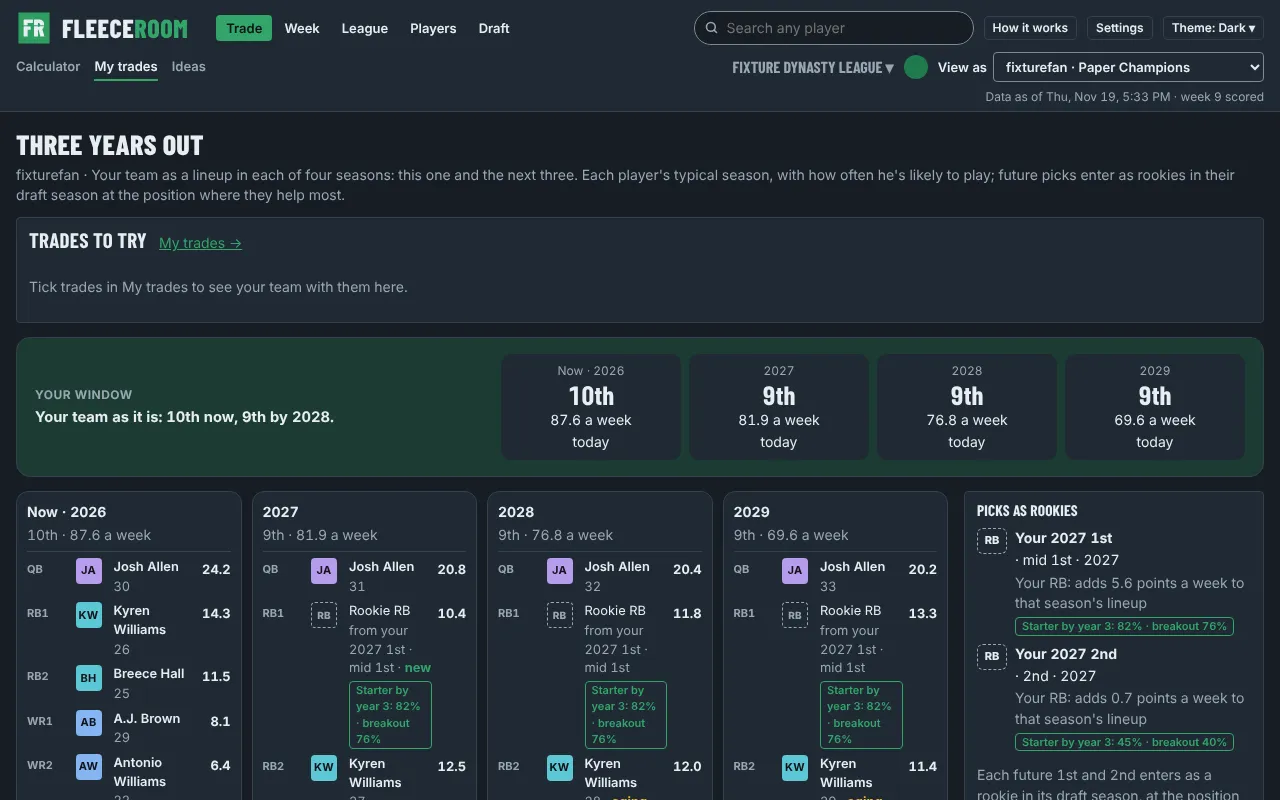
A dynasty team's window is the stretch of seasons it can win in. Some teams are built for this year, some for two years from now, and some are in between. FleeceRoom's Three years out projects your lineup for the season now and each of the next three, ranks it against every team in your league, and shows how a trade would change it.
Open FleeceRoom with your league
How the window is worked out
For each of the next three seasons, every quarterback, running back, receiver and tight end has a projection: points a game in a bad, typical and good season, and how many games he's expected to play. FleeceRoom builds each team's best lineup for each season from those numbers, with your league's own lineup slots, and ranks the teams by their best lineup's points a week.
- The window is your rank in each season: for example 3rd now, 5th next year, 8th and 10th after that.
- Every team's window sits beside it as a grid of ranks, so you can see who is rising and who is about to fall.
- Four lineups side by side show each player's age that season, "aging" when his projection is falling at an age when players at his position decline, "new" when he first enters, and his points a game.
- Aging out lists the players whose points fall the most over the three seasons.
The projections start from each player's last three seasons and compare him with hundreds of similar past players since 2006. The dynasty rankings use the same projections.
Picks become rookies
Your future picks enter the lineup in their draft season as rookies, shown as dashed tiles such as "Rookie QB, from your 2027 1st". Each one goes where it adds the most to your lineup, its best use, and scores what past rookies from that part of the draft scored. A side panel says why: "Your QB from 2028". The rookie pick values guide has the numbers behind it.
Trades to try
Tick a trade in My trades and Three years out applies it, with roster cuts and moves for both teams. The window and the lineups switch to "with these trades": arrivals are marked, each season lists who's gone, and each year shows its change against today's roster. Tick two trades and they apply in the order you ticked them; two trades that send the same player get a warning.
The window shows up beside trades too. Every match in the calculator and every trade idea carries a window line for both teams, your ranks before and after, so a trade that wins this year and costs you the next two is visible before you send it. When a contending partner's rank two seasons out would fall four places or more, FleeceRoom marks the trade "Maybe" rather than "Likely": he'd be aging out.
Reading your window
A team that ranks near the top now and falls fast is a seller's candidate later, a buyer's now. A team that ranks low now and climbs is a rebuild that's working; it can trade a veteran for youth without losing much. A team in the middle every year has the hardest choice, and the window shows which way a trade pushes it. Before the deadline, the trade deadline guide covers what each direction should do.
Frequently asked questions
What scoring do the projections use?
The nearest of six presets to your league's scoring: full, half or no PPR, with 4- or 6-point passing touchdowns.
How accurate are three-season projections?
Tested on seasons the model never saw, it missed by about 2.7 points a game one season out and about 3.2 three seasons out. Breakouts and collapses can't be called ahead of time, so read the range.
Does it account for players changing teams?
Yes, once a player's new team is known: a trade, or free agency from March. Players who move have tended to score a little less the next season, and the projection applies that.
Is Three years out available in redraft leagues?
No. A redraft league has no future seasons or picks, so FleeceRoom leaves it out.
Where does the data come from?
Historical NFL stats from nflverse, CC BY 4.0, and Sleeper's player list for teams and ages.